Karol Majewski
Program director & scout
What do you do at Analogue?
I scout the outer edges of human activity and identify people, ideas and projects worth betting on. I also develop my own ideas when they’re aligned with Analogue’s raison d'être.
I like to think of myself as a systems humanist1 interested in finding skillful ways to cooperate with life. Just like a biologist studies how lifeforms emerge, develop, remix, reproduce and perish, I do the same with things not typically considered lifeforms, such as: ideas, paradigms, companies, institutions. You could say I'm a student of novelty and life itself.
What’s your background?
Academically, I was trained as an engineer. My focus was renewable energy sources. But I spent almost a decade in software, building products with early-stage startups.
That being said, no matter what I was doing, what seemed most interesting wasn't always what my job title would suggest. I was curious about systems, processes and their underlying principles. For example, I wanted to know why certain people consistently have good ideas while the ideas of others rarely survive contact with reality. Or why some teams can create magic while others collapse under their own weight. The central question seemed to be: what wants to happen? And what stands in the way?
And so I decided to investigate this question more directly. I looked into self-organization, process philosophy, complexity science, organization design, coordination problems, and collective intelligence attractors, amongst many others.
How would you describe Analogue’s approach?
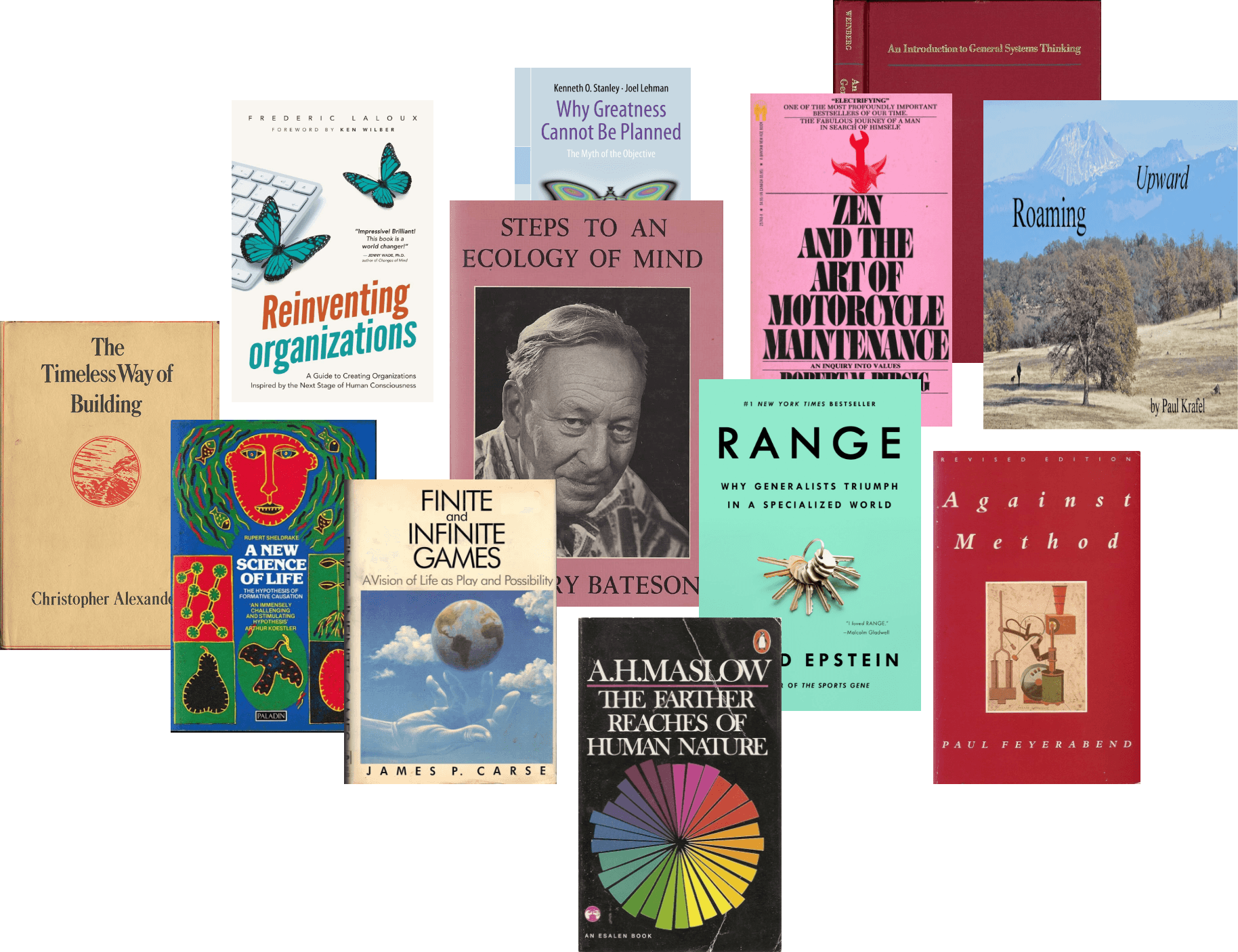
I can’t speak for the entire team, but I’d say it’s synthetic, holistic and interdisciplinary. Naturalistic even, if you consider technology to be a valid expression of nature. If you’re familiar with some of these books, you might guess what we’re into.
Is there a quote that captures the essence of what you do at Analogue?
I like this one from Robert Pirsig. It’s about the tendency of systems to return to a trajectory unless the thinking behind the system is changed.
But to tear down a factory or to revolt against a government or to avoid repair of a motorcycle because it is a system is to attack effects rather than causes; and as long as the attack is upon effects only, no change is possible. The true system, the real system, is our present construction of systematic thought itself, rationality itself, and if a factory is torn down but the rationality which produced it is left standing, then that rationality will simply produce another factory. If a revolution destroys a systematic government, but the systematic patterns of thought that produced that government are left intact, then those patterns will repeat themselves in the succeeding government. There’s so much talk about the system. And so little understanding.
Zen and the Art of Motorcycle Maintenance: An Inquiry Into Values
What’s it like to do what you do at Analogue?


What do you believe that others don’t?
I think you should definitely judge the book by its cover. A lot of information we care about is contained implicitly in form or aesthetics. I’d say it’s perfectly rational to use beauty as your north star.
Why will Analogue succeed?
Nobody knows if Analogue will succeed. Analogue is, before anything else, an experiment. Such answer may look like lack of conviction, but in my line of work, being realistic is important. Even the loftiest ideals are worthless unless they connect to present-day reality somehow.
That being said, I think Analogue's edge lies in being free in ways others are not. For one, we are under no obligation to subscribe to any one epistemic principle or framework. We can use the scientific method where it's applicable, but also recognize that every method has its operating range beyond which it fails to deliver useful results. If you study the history of innovation, you'll find that rigorous logic, still so cherished by modern science, was often abandoned in favor of more creative approaches.
We also don't care much about credentials. We consider them a poor proxy for either talent or clarity of thought. We prefer to look for these qualities directly. This gives us access to brilliance waiting to be discovered off the beaten path.
That is not to say that limitations are bad. We have other limitations. We need to be scrappy. We can't expect institutional support. But these are limitations we have chosen and which are aligned with what we aim to accomplish. There is freedom in constraints.
What’s one unexpected influence that has shaped your thinking?
I’d say Tao Te Ching. It was intended as a manual for rulers, but it also happens to be the oldest written work on what today we would call complexity science, implicit knowing, and what is sometimes referred to as right-brain cognition. These ways of knowing have a special place in my heart. I predict they will make a big comeback soon.
Where can we find you online?
I use X (Twitter), are.na and Cosmos.
- This term was originally coined by Ted Nelson. He modeled this self-description after Buckminster Fuller, emphasizing a blend of technological innovation with broader humanistic and societal vision. On his official website, Nelson states: “Theodor Holm Nelson, born 1937, calls himself not a techie or a geek, but a ‘systems humanist,’ like Buckminster Fuller.” ↩